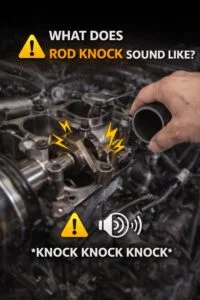
Engine noises come in many forms, but few cause as much concern as rod knock. It is a sound that seasoned mechanics recognize instantly and drivers remember for years.
Unlike light ticking or brief rattles, rod knock has a heavy, hollow tone that feels serious the moment it appears. Some people first hear it as a faint thud during acceleration. Others notice it after an oil issue or overheating event.
In many cases, the sound grows louder and more frequent until it can no longer be ignored. Rod knock is not just a noise. It is the audible result of internal engine parts no longer fitting together the way they should.
Once it starts, it rarely goes away on its own. Learning how rod knock actually sounds, how it behaves at different speeds, and how it differs from other engine noises helps identify the problem early.
This guide explains rod knock in clear terms, focusing on sound characteristics, common triggers, progression over time, and why quick decisions matter once it appears.
What Rod Knock Refers To Inside The Engine
Rod knock comes from the connecting rod bearings inside the engine.
Each piston is connected to the crankshaft by a connecting rod. At the base of that rod is a bearing that allows smooth rotation around the crankshaft journal.
These bearings rely on a thin film of pressurized oil to prevent metal-to-metal contact.
When that oil film fails or the bearing wears excessively, the rod develops clearance. As the crankshaft rotates, the rod begins to strike the crank journal instead of gliding smoothly.
That impact is what creates rod knock.
The Basic Sound Of Rod Knock
Rod knock sounds like a deep, metallic knocking or thudding noise coming from the engine block.
It is often described as:
- A dull hammering sound
- A heavy tapping or knocking
- A rhythmic thud that follows engine speed
Unlike sharp ticks or clicks, rod knock has weight to it. The sound feels solid and mechanical rather than light or fast.
It usually comes from deep within the engine, not the top end.
How Rod Knock Changes With Engine Speed
Rod knocks almost always change with RPM.
At idle, it may sound like a slow, steady knock that comes and goes. As engine speed increases, the knocking becomes faster and more pronounced.
Under acceleration, rod knock often grows louder because load increases pressure on the connecting rods.
At steady cruising, the sound may soften slightly, only to return strongly when throttle input changes.
This RPM-related behavior is one of the strongest clues pointing to rod knock.
How Rod Knock Sounds Under Acceleration
Acceleration is when rod knock is often most noticeable.
As engine load increases, the force on the connecting rods rises sharply. Worn bearings cannot cushion that force.
The result is a louder, deeper knock when the gas pedal is pressed.
Drivers often describe this as:
- A knocking that appears only when accelerating
- A sound that fades when coasting
- A noise that feels tied to engine effort
This pattern separates rod knock from many harmless noises.
How Rod Knock Sounds At Idle
At idle, rod knock may sound inconsistent at first.
It can appear as:
- A faint knock every few seconds
- A dull thud that comes and goes
- A sound that disappears briefly when engine speed changes
As damage progresses, the idle knock usually becomes constant.
Early-stage rod knock can be mistaken for other noises because it is quieter at idle than under load.
Cold Engine Versus Warm Engine Sound
Rod knock behavior can change with temperature.
In some cases, the sound is louder when the engine is cold and improves slightly as oil warms and thickens.
In other cases, the knock becomes worse as the engine heats up and oil thins.
Either pattern can occur depending on bearing wear, oil condition, and engine design.
Once rod knock is clearly audible, temperature changes rarely eliminate it completely.
How Rod Knock Differs From Engine Ping Or Detonation
Rod knock is often confused with engine ping or detonation, but they are very different.
Engine ping:
- Sounds lighter and sharper
- Occurs mainly under load
- Often linked to fuel quality or timing
- Does not usually appear at idle
Rod knock:
- Sounds deep and heavy
- Follows engine speed closely
- Occurs at idle and under load
- Comes from mechanical clearance
Ping comes from combustion issues. Rod knock comes from mechanical wear.
How Rod Knock Differs From Lifter Noise
Lifter noise is another common confusion point.
Lifter noise:
- Sounds like fast ticking or tapping
- Comes from the top of the engine
- Increases with RPM but stays light
- Often improves with oil pressure
Rod knock:
- Comes from the bottom of the engine
- Has a slower, heavier rhythm
- Does not disappear with oil pressure
- Feels deeper and more serious
Listening location matters when distinguishing these sounds.
How Rod Knock Differs From Main Bearing Noise
Main bearing noise also involves the crankshaft but behaves differently.
Main bearing issues often produce:
- A low rumbling sound
- Vibration through the engine
- Noise that may not change sharply with RPM
Rod knock tends to be more rhythmic and pronounced, especially during throttle changes.
Both are serious, but rod knock is usually easier to identify by sound alone.
Why Oil Problems Often Trigger Rod Knock
Oil plays a critical role in bearing protection.
Low oil level, poor oil quality, or oil starvation interrupts the protective oil film.
Common oil-related triggers include:
- Running the engine low on oil
- Oil pump failure
- Clogged oil passages
- Incorrect oil viscosity
Once metal contact begins, bearing damage accelerates rapidly.
How Overheating Leads To Rod Knock
Overheating thins oil and weakens bearing material.
Extreme heat can cause bearings to deform or lose their protective coating.
Once the bearing surface is damaged, normal oil pressure may no longer protect it.
Overheating events often mark the beginning of rod knock, even if symptoms appear later.
How Long Rod Knock Can Go On Before Failure
Rod knock does not have a predictable timeline.
Some engines fail within minutes. Others may run for weeks or months with light knocking.
Factors that influence progression include:
- Severity of bearing wear
- Engine load and usage
- Oil quality and pressure
- Driving habits
Every mile driven with rod knock increases the risk of catastrophic failure.
Why Rod Knock Usually Gets Worse Over Time
Bearing wear increases clearance with every rotation.
As clearance grows:
- The knock becomes louder
- Oil pressure drops
- Heat increases
- Metal debris spreads through the engine
This creates a cycle that accelerates damage.
Rod knock almost never stays stable for long.
Can Rod Knock Come And Go
In early stages, rod knock may seem intermittent.
It may:
- Appear only when hot
- Disappear briefly after an oil change
- Change volume with driving conditions
These temporary changes often create false hope.
Once bearing damage exists, the problem continues internally regardless of sound variation.
Why Adding Thicker Oil Changes The Sound
Some drivers notice rod knock quiets after using thicker oil.
Heavier oil can:
- Increase oil film thickness
- Reduce noise temporarily
- Mask symptoms briefly
This does not repair the bearing.
Thicker oil only delays progression and may create other lubrication issues.
Where The Sound Is Usually Heard From
Rod knock usually comes from:
- The lower engine block
- The oil pan area
- Beneath the engine rather than the valve cover
Using a mechanic’s stethoscope or listening near the oil pan often reveals the strongest sound.
Sound location helps separate rod knock from top-end noise.
Why Ignoring Rod Knock Is Risky
Rod knock can lead to severe engine damage.
Possible outcomes include:
- Spun bearings
- Crankshaft damage
- Connecting rod failure
- Engine seizure
- Block damage
A failed rod can puncture the engine block, making repair impossible.
What Happens When A Rod Bearing Spins
A spun bearing occurs when the bearing shell rotates inside its housing.
This blocks oil flow and causes instant overheating.
The knock usually becomes much louder right before failure.
At this stage, engine shutdown is the only way to limit further damage.
Can Rod Knock Be Fixed Without Rebuilding
True rod knock requires internal repair.
Temporary measures may reduce noise but do not restore bearing integrity.
Real fixes involve:
- Bearing replacement
- Crankshaft inspection or machining
- Engine rebuild or replacement
Once the knock is audible, internal repair is unavoidable.
How Mechanics Confirm Rod Knock
Diagnosis often includes:
- Listening tests under load
- Oil pressure measurement
- Oil filter inspection for metal
- Engine teardown if needed
Metal flakes in oil are a strong indicator of bearing damage.
Sound combined with oil evidence confirms the diagnosis.
Why Rod Knock Sometimes Appears Suddenly
Many engines wear gradually until a tipping point is reached.
Oil starvation, overheating, or a sudden load can push a worn bearing past its limit.
The sound appears suddenly, even though damage developed over time.
Sudden onset does not mean sudden cause.
Driving With Rod Knock Versus Towing
Continuing to drive risks total engine loss.
If the vehicle must be moved:
- Keep RPM as low as possible
- Avoid acceleration
- Minimize distance
Towing is always safer once rod knock is suspected.
Preventing Rod Knock In Healthy Engines
Prevention focuses on lubrication and temperature control.
Key practices include:
- Regular oil changes
- Maintaining correct oil level
- Addressing overheating promptly
- Using proper oil viscosity
- Responding quickly to oil pressure warnings
Healthy oil protects bearings better than any additive.
Common Myths About Rod Knock
Some believe rod knock is harmless noise. It is not.
Others think additives can fix it permanently. They cannot.
Another myth is that engines can run forever with rod knock. Most cannot.
Misconceptions often delay necessary decisions.
When Replacement Makes More Sense Than Repair
In high-mileage engines, rebuild costs may exceed vehicle value.
Replacement engines or vehicles may be more practical.
Evaluating cost versus outcome helps avoid throwing money at a failing engine.
Final Thoughts
Rod knock has a distinct voice. It is deep, metallic, and closely tied to engine speed and load. Once heard clearly, it signals that internal engine parts are no longer protected the way they should be. While other noises can mimic it at first, rod knock stands out by its weight, rhythm, and persistence.
Catching the sound early allows better choices, whether that means shutting the engine down, planning a repair, or avoiding further damage. Ignoring it almost always leads to worse outcomes. Paying attention to how the engine sounds is one of the simplest ways to protect it from irreversible failure.