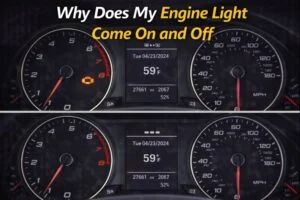
Modern cars are packed with sensors quietly watching how the engine, transmission, and emissions systems behave. Whether you’re driving a compact hatchback, a family sedan, or a midsize SUV, the check engine light acts as the car’s way of asking for attention.
Unlike warning lights that stay on constantly, an engine light that turns on, then disappears days later, creates confusion. Is it a real problem or just a temporary glitch? The answer is usually more nuanced than a simple yes or no.
Intermittent engine lights are common, and in many cases they point to conditions that come and go rather than outright failures.
This article explains why the engine light behaves this way, what systems are involved, which situations are harmless, which ones are not, and how professionals approach diagnosing an on-and-off warning without guesswork or unnecessary repairs.
Short Note
This article is based on long-established diagnostic practices, emissions system operation principles, and manufacturer service documentation used across the automotive industry.
Information was reviewed alongside explanations and technical guidance published by high-authority automotive sources such as Car and Driver, MotorTrend, and Edmunds, which regularly cover engine diagnostics, emissions behavior, and real-world troubleshooting patterns.
What the Engine Light Actually Monitors
The check engine light is linked to the car’s onboard diagnostic system. Its job is to alert the driver when the engine or emissions system operates outside expected limits. It doesn’t directly measure damage.
Instead, it watches data from dozens of sensors and looks for patterns that don’t match what the vehicle’s computer expects.
If a condition happens once and then corrects itself, the system may store a record but turn the light off. If it happens repeatedly or consistently, the light stays on. This design helps prevent false alarms while still protecting the engine and emissions components.
Why an Engine Light Can Turn Itself Off
An engine light that goes off by itself usually means one of two things:
- The problem was temporary and did not repeat
- The system detected the issue, stored it as a pending fault, and waited to see if it returned
Most vehicles require a fault to occur multiple times across different drive cycles before keeping the light on. This is intentional. Engines experience brief changes in temperature, pressure, and airflow that don’t always indicate a true failure.
The Most Common Causes
Intermittent engine lights usually point to borderline conditions rather than hard failures. Below are the most common real-world causes.
1. Loose or Aging Gas Cap
This is one of the most frequent and least serious reasons.
Why it affects the engine light
The fuel system is sealed to control fuel vapors. A loose, cracked, or worn gas cap allows vapors to escape, triggering an emissions fault.
Why the light turns off
If the cap seals properly again after refueling or temperature changes, the system may pass its self-test and turn the light off.
What to do
- Tighten the cap until it clicks
- Inspect the seal for cracks
- Replace the cap if it’s old or damaged
If this was the cause, the light usually stays off after a few normal drive cycles.
2. Temperature-Sensitive Sensors
Many engine sensors react differently when the engine is cold versus fully warm.
Common examples
- Oxygen sensors
- Coolant temperature sensors
- Intake air temperature sensors
Why the light is intermittent
A sensor may give borderline readings only when cold or only when hot. Once the engine reaches a different temperature range, the reading returns to normal and the light goes out.
This is often an early warning sign of a sensor beginning to age.
3. Minor Misfires That Don’t Happen All the Time
A misfire occurs when combustion doesn’t happen correctly in one or more cylinders.
Why it can be inconsistent
- Worn spark plugs
- Aging ignition coils
- Moisture in ignition components
- Slight vacuum leaks
If misfires happen briefly and then stop, the system may not keep the light on continuously.
Why this matters
Even small misfires can damage the catalytic converter over time if ignored.
4. Vacuum Leaks That Seal Themselves Temporarily
Engines rely on precise airflow. Small leaks can upset that balance.
How this causes on-and-off behavior
- Rubber hoses expand when warm and shrink when cold
- Cracked hoses may seal briefly as they heat up
- Engine movement can open and close small leaks
When the leak is present, the light comes on. When it seals itself, the light goes off.
5. Fuel Quality Issues
Fuel that doesn’t burn as expected can confuse engine sensors.
Common situations
- Low-quality fuel
- Water contamination
- Seasonal fuel blend changes
Once the questionable fuel is diluted with fresh fuel or burned off, sensor readings return to normal and the light disappears.
6. Exhaust or Emissions Components Reacting to Conditions
The emissions system runs periodic self-tests rather than constant checks.
Components involved
- Evaporative emissions system
- Oxygen sensors
- Exhaust gas recirculation system
If a self-test fails once but passes later, the light may turn off even though a stored code remains in memory.
7. Electrical Connections with Minor Corrosion
Modern vehicles rely on clean electrical signals.
Why the light can be intermittent
- Slight corrosion at connectors
- Loose ground connections
- Moisture after rain or washing
When resistance increases, sensors may report faulty data. When the connection improves, readings return to normal.
What the Engine Computer Does Behind the sScenes
The vehicle’s computer follows strict rules before keeping the engine light on.
- A fault must occur under specific conditions
- The same fault often must repeat on separate trips
- The system tracks “pending” issues separately from confirmed ones
This is why a scan tool can sometimes show a stored code even when the light is currently off.
When an On-and-Off Engine Light is Safe to Ignore (temporarily)
In limited cases, monitoring is reasonable.
Generally acceptable short-term situations:
- Light came on after refueling and went off after tightening the cap
- No change in engine behavior
- No unusual sounds, smells, or vibrations
Even then, it’s wise to check stored codes.
When You Should Not Ignore It
An engine light that behaves intermittently still deserves attention if:
- It comes back repeatedly
- Engine runs rough at any point
- Fuel economy drops noticeably
- The light flashes at any time
- You notice hesitation, stalling, or loss of power
A flashing engine light indicates active misfires and should be treated as urgent.
How Professionals Diagnose Intermittent Engine Lights
Technicians don’t guess. They follow patterns.
Step 1: Scan for stored and pending codes
Even if the light is off, codes often remain stored.
Step 2: Review freeze-frame data
This shows what the engine was doing when the fault occurred.
Step 3: Look for patterns
Temperature, speed, fuel trim, and load often point to the real cause.
Step 4: Inspect likely components
Based on the data, a technician inspects specific hoses, sensors, or wiring instead of replacing parts blindly.
Common Mistakes Drivers mMake
- Clearing codes without diagnosing the cause
- Ignoring repeated warnings because the light turns off
- Replacing parts without confirming failure
- Assuming the problem fixed itself
Intermittent problems usually get worse, not better.
Costs: What to Expect
Because causes vary, costs vary too.
- Diagnostic scan: $50–$150
- Gas cap replacement: $10–$40
- Sensor replacement: $100–$400
- Ignition components: $150–$600
- Vacuum leak repair: $50–$300
Early diagnosis almost always costs less.
How to Reduce the Chances of Intermittent Engine Lights
- Replace spark plugs at recommended intervals
- Use quality fuel from reputable stations
- Inspect hoses during routine maintenance
- Address small drivability changes early
- Avoid repeatedly driving with warning lights ignored
Preventive maintenance reduces borderline conditions that trigger temporary faults.
Final Thoughts
An engine light that turns on and off is not random. It’s the vehicle reporting that something occasionally falls outside normal limits. While some causes are minor, others are early warnings of problems that grow over time.
The key is not panic, but attention. Checking stored codes, watching for patterns, and addressing issues early keeps repairs manageable and prevents secondary damage.
If the light keeps returning, the car is asking for a closer look — and listening early usually saves money and frustration later.