
Nissan’s CVT transmission has been a major part of the brand’s lineup for years, helping deliver smooth acceleration and improved fuel efficiency across many popular models.
On paper, the design makes sense. Instead of traditional gears, a continuously variable transmission uses belts and pulleys to keep the engine operating at optimal speed. When everything works as intended, the result feels seamless and quiet.
Over time, however, many owners have learned that CVT problems rarely announce themselves all at once. Failure usually begins with small changes that are easy to dismiss — a strange hesitation, a new sound, or behavior that feels slightly off but not alarming.
These early signs matter. CVT issues tend to progress rather than stabilize, and ignoring the symptoms often leads to sudden loss of performance or complete transmission failure.
This article breaks down the real-world symptoms of Nissan CVT transmission failure, how they usually develop, and why catching them early can make a significant difference.
Why Nissan CVT Problems Tend To Develop Gradually
The CVT design relies on precise hydraulic pressure, belt tension, and electronic control. Unlike traditional automatic transmissions, there are fewer mechanical buffers when something begins to slip or lose calibration. Small changes in fluid condition, heat buildup, or sensor feedback can quickly affect how the transmission behaves.
In many Nissan vehicles built during certain years, CVT units were pushed to handle daily driving demands with tight tolerances. When fluid degrades or internal components wear unevenly, the system compensates for a while. That compensation masks the problem, but it also accelerates wear. By the time symptoms become obvious, internal damage may already be underway.
Early Warning Signs That Often Go Unnoticed
One of the first signs many drivers report is hesitation during acceleration. The engine revs climb, but the car does not respond immediately. It may feel as if the vehicle is thinking before moving forward. This delay is subtle at first and often blamed on traffic conditions or throttle response.
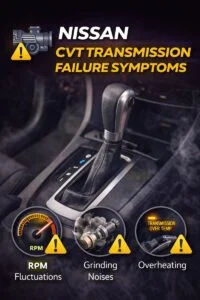
Another early symptom is inconsistent engine RPM behavior. The engine may surge or fluctuate while maintaining a steady speed. This is not normal CVT operation and usually indicates belt slip or pressure control issues inside the transmission.
Some drivers notice a faint whining or humming sound that rises and falls with speed. CVTs naturally make some noise, but a new or louder sound — especially one that grows over time — often points to internal wear.
Shuddering And Vibration During Light Driving
As CVT wear progresses, shuddering becomes more noticeable. This often occurs at low speeds or during gentle acceleration. The sensation feels like driving over a rumble strip or mild road vibration, even on smooth pavement.
Shuddering is commonly linked to degraded transmission fluid or uneven belt contact. Nissan CVTs are particularly sensitive to fluid condition. Old or overheated fluid loses its ability to maintain consistent pressure, which allows the belt to slip momentarily.
This symptom is frequently misdiagnosed as an engine or mount issue. However, when shuddering appears without engine misfires or suspension problems, the CVT should be closely evaluated.
Overheating And Power Reduction Behavior
Many Nissan CVT-equipped vehicles include protective programming that limits power when the transmission overheats. Drivers may suddenly feel reduced acceleration, sluggish response, or an inability to maintain highway speed.
This behavior is often temporary at first. After stopping and allowing the vehicle to cool, normal performance may return. Unfortunately, this is not a fix — it is a warning. Repeated overheating accelerates internal damage and shortens transmission life dramatically.
In some cases, a dashboard warning message related to transmission temperature appears. In others, the system quietly limits power without an obvious alert, making the issue harder to recognize.
Delayed Engagement And Slipping Sensations
Another common symptom is delayed engagement when shifting from Park to Drive or Reverse. Instead of moving immediately, the car may pause for a second or two before engaging, sometimes accompanied by a clunk or jolt.
Slipping can also occur while driving. The engine speed rises unexpectedly without a matching increase in vehicle speed. This is one of the clearest signs of CVT belt or pulley wear and should never be ignored.
Unlike traditional transmissions, CVTs do not tolerate prolonged slipping. Once this symptom appears, internal damage often progresses quickly.
Warning Lights And Diagnostic Clues
As CVT problems worsen, warning lights may appear. These can include the check engine light, transmission warning messages, or reduced power indicators.
Diagnostic scans often reveal pressure control codes, ratio errors, or temperature-related faults. While codes alone do not confirm full transmission failure, they provide strong evidence that the CVT is struggling to operate within design limits.
It is important to note that clearing codes without addressing the cause does not resolve the issue. The system will re-detect the fault once conditions repeat.
How CVT Failure Feels Different From Other Transmission Issues
CVT problems feel different from traditional automatic transmission failures. Instead of harsh gear changes, drivers experience hesitation, inconsistent power delivery, and a lack of direct connection between engine speed and vehicle movement.
This difference is why many owners delay seeking service. The car still moves, and there may be no loud noises or dramatic symptoms at first. Unfortunately, by the time movement becomes severely limited, repair options are often more expensive.
Models Commonly Affected By CVT Issues
Many Nissan models have used CVT transmissions over the years, including sedans, crossovers, and compact SUVs. While not every vehicle experiences problems, certain production years have higher failure rates.
Vehicles like the Rogue, Altima, Sentra, and Pathfinder have been widely discussed due to CVT-related complaints. Driving habits, maintenance history, and climate also play a role in how long the transmission lasts.
It is important to avoid assuming all Nissan CVTs fail early. Some units perform well with proper maintenance and moderate driving conditions. However, awareness of symptoms remains critical.
Why Fluid Maintenance Matters More Than Most Owners Expect
CVT fluid does far more than lubricate. It controls hydraulic pressure, cools internal components, and maintains belt grip. Once fluid breaks down, the entire system suffers.
Unlike traditional automatic transmissions, CVTs are far less forgiving of delayed fluid service. Even when no symptoms are present, degraded fluid quietly accelerates wear.
Many failures trace back to extended fluid intervals or the use of incorrect fluid types. Nissan CVTs require specific formulations, and substitutes often cause long-term damage.
Can CVT Problems Be Fixed Or Only Replaced
In early stages, some CVT symptoms improve with fluid service and software updates. This is most effective when shuddering or hesitation has just begun and internal damage is minimal.
Once slipping, overheating shutdowns, or repeated warning lights appear, repair options become limited. Internal CVT components are complex and not easily rebuilt in many cases. Full replacement is often recommended.
This is why recognizing symptoms early matters. Addressing issues at the first signs can significantly change the outcome.
What Happens If Symptoms Are Ignored
Ignoring CVT symptoms usually leads to one of two outcomes. Either the transmission enters permanent limp mode, limiting speed and drivability, or it fails completely and leaves the vehicle unable to move.
At that stage, replacement costs are significantly higher, and resale value drops sharply. What could have been a controlled repair becomes an urgent and expensive decision.
Ownership Decisions And Realistic Expectations
CVT ownership requires awareness rather than fear. Knowing what behavior is normal and what is not allows owners to act before damage becomes severe.
Regular maintenance, attention to early symptoms, and avoiding excessive heat buildup all help extend CVT life. While the design has limitations, informed ownership makes a measurable difference.
Final Thoughts
Nissan CVT transmission failure rarely arrives without warning. It announces itself through hesitation, shuddering, slipping, overheating behavior, and subtle changes in how the car responds. These symptoms are not random quirks — they are signals that the system is struggling to maintain internal balance.
The key is timing. When symptoms are addressed early, options remain open and costs stay manageable. When they are ignored, failure often escalates quickly. Understanding these warning signs allows owners to make calm, informed decisions instead of reacting to a sudden breakdown. For vehicles equipped with Nissan CVTs, awareness is not optional — it is part of responsible long-term ownership.