When people talk about cars, engine size often comes up early in the conversation. Someone might say a car has a 2.0-liter engine, a 3.5-liter V6, or a small 1.2-liter motor. These numbers sound important, but many drivers are never fully told what they actually represent.
Engine liters are often treated like a badge of strength or weakness, even though the meaning behind the number is more mechanical than emotional. Engine liters are not about fuel capacity, oil volume, or how much power the engine makes on their own.
They describe something very specific inside the engine, something tied directly to how air and fuel move through it. Once you understand what engine liters mean, a lot of other things start to make sense, from why some cars feel quick off the line to why others focus on efficiency.
This explanation breaks it down in plain terms, without technical overload, so the number on the badge finally has real meaning.
Engine Liters Are A Measure Of Engine Size
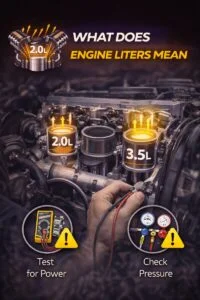
Engine liters describe the total internal volume of all the engine’s cylinders. This volume is called engine displacement.
In simple terms, displacement is the amount of air an engine can draw in during one complete cycle. That air mixes with fuel, gets compressed, and ignites to create power.
The larger the displacement, the more air and fuel the engine can process at once. That is why engine liters are often associated with power, even though they are not the whole story.
The number is expressed in liters or sometimes cubic centimeters. For example, a 2.0-liter engine has a total displacement of 2,000 cubic centimeters.
How Displacement Is Calculated Inside The Engine
An engine is made up of cylinders, pistons, and a crankshaft. Each cylinder has a piston that moves up and down.
The space inside a cylinder, from the top of the piston to the bottom of its stroke, is the cylinder’s volume. When you add the volume of all cylinders together, you get total engine displacement.
For example:
- A four-cylinder engine with 0.5 liters per cylinder equals 2.0 liters
- A six-cylinder engine with 0.5 liters per cylinder equals 3.0 liters
The number of cylinders and their size both matter. More cylinders usually mean smoother operation, while larger cylinders usually mean more torque.
Why Liters Are Used Instead Of Cubic Inches
In some regions, engine size used to be expressed in cubic inches. Today, liters are the global standard.
Liters are easier to compare, simpler to scale, and fit better with modern engineering measurements. Almost all manufacturers now use liters regardless of where the car is sold.
That is why you see 1.6L, 2.5L, or 4.0L instead of older measurements.
What A Larger Engine Liter Number Generally Means
A larger engine displacement usually allows the engine to move more air and fuel per cycle. This typically leads to:
- More low-end torque
- Stronger acceleration without revving high
- Better performance under heavy load
That is why trucks, SUVs, and performance cars often use larger engines. They need that extra airflow capacity to move weight or deliver strong acceleration.
However, bigger engines also consume more fuel when working hard, which is why efficiency becomes a trade-off.
What A Smaller Engine Liter Number Typically Indicates
Smaller displacement engines move less air and fuel with each cycle. This usually leads to:
- Better fuel efficiency
- Lower emissions
- Lighter engine weight
Smaller engines are common in compact cars, city vehicles, and economy-focused models. They work efficiently at moderate speeds and light loads.
To compensate for lower displacement, manufacturers often use higher engine speeds, advanced valve timing, or turbochargers.
Engine Liters Do Not Equal Horsepower
One of the biggest misunderstandings is assuming engine liters directly equal horsepower.
A modern 2.0-liter engine can easily make more power than an older 3.0-liter engine. Technology plays a huge role.
Factors that affect power include:
- Turbocharging or supercharging
- Engine design and compression ratio
- Fuel injection systems
- Valve timing and airflow efficiency
Engine liters tell you how big the engine is, not how advanced it is.
Why Turbocharged Engines Changed Everything
Turbochargers force extra air into the engine, allowing smaller engines to behave like larger ones.
A turbocharged 2.0-liter engine can produce power similar to a naturally aspirated 3.0-liter engine, while using less fuel during light driving.
This is why many modern vehicles use smaller turbocharged engines instead of larger naturally aspirated ones.
Engine liters still matter, but boost pressure changes how much work that displacement can do.
Engine Liters And Torque Explained Simply
Torque is the twisting force an engine produces. It is what gets a car moving from a stop.
Larger engines tend to produce more torque at lower engine speeds because they move more air per rotation.
Smaller engines often need to rev higher to make similar torque, which changes how the car feels to drive.
This is why larger engines often feel relaxed and strong, while smaller engines feel busy or high-revving.
How Engine Size Affects Fuel Consumption
Engine displacement plays a major role in fuel usage, but it is not the only factor.
A larger engine burns more fuel when producing power, but at steady cruising speeds, the difference may be smaller than expected.
A small engine working hard can sometimes use as much fuel as a larger engine working lightly.
Driving style, gearing, vehicle weight, and aerodynamics all influence real-world fuel economy.
Engine Liters And Vehicle Weight Connection
Engine size is often matched to vehicle size and weight.
Heavier vehicles need more torque to accelerate smoothly. That is why larger vehicles often come with larger engines.
Putting a small engine in a heavy vehicle leads to constant high load, which increases wear and fuel use.
Manufacturers balance engine size with vehicle weight to achieve acceptable performance and efficiency.
Why Engine Size Alone Does Not Define Performance
Two engines with the same displacement can feel completely different.
Engine tuning, transmission gearing, and throttle response all influence how power is delivered.
One engine may feel quick off the line, while another feels stronger at higher speeds, even if both are 2.0 liters.
That is why test driving matters more than just reading specifications.
Engine Liters And Longevity Considerations
Larger engines often operate at lower stress levels because they do not need to work as hard for the same output.
Smaller engines, especially turbocharged ones, may operate under higher pressure and heat more often.
This does not mean smaller engines are unreliable, but maintenance becomes more important.
Oil quality, cooling systems, and service intervals matter regardless of engine size.
Common Engine Liter Examples Explained
A 1.5-liter engine is common in compact cars and small sedans. It focuses on efficiency and daily usability.
A 2.0-liter engine is a popular middle ground, offering a balance of performance and fuel economy.
A 3.0-liter engine often appears in larger sedans, SUVs, and performance vehicles, delivering stronger acceleration.
A 5.0-liter engine is typically associated with high-performance or heavy-duty use, where torque and sound matter as much as speed.
Why Cylinder Count And Engine Liters Are Different
People often confuse engine liters with cylinder count.
A four-cylinder engine can be 2.0 liters, while a six-cylinder engine can also be 2.0 liters.
Cylinder count affects smoothness and sound, while displacement affects airflow capacity.
More cylinders usually mean smoother operation, not necessarily more power.
Engine Liters And Emissions Regulations
Modern emissions standards influence engine size choices.
Smaller engines help manufacturers meet emission targets, especially when combined with turbocharging and advanced controls.
This is why engine sizes have generally decreased over time, even as performance has improved.
Engine liters today reflect efficiency goals as much as power goals.
Why Bigger Is Not Always Better
A larger engine is not automatically the best choice for every driver.
City driving, short trips, and light loads favor smaller engines.
Long highway trips, towing, or spirited driving may benefit from larger displacement.
Choosing the right engine size depends on how the vehicle is actually used.
How Engine Liters Affect Insurance And Ownership Costs
Engine size can influence insurance rates in some regions, especially for performance-oriented vehicles.
Larger engines may also mean higher fuel costs and potentially higher maintenance costs.
However, a well-matched engine often lasts longer and feels more comfortable to live with.
Ownership experience matters more than raw numbers.
Why Manufacturers Still Advertise Engine Size
Even with modern technology, engine liters remain an easy reference point.
They give buyers a quick idea of where a vehicle sits in terms of capability.
While not a complete performance measure, engine size still provides useful context.
That is why manufacturers continue to list it prominently.
How To Use Engine Liters When Choosing A Car
Instead of treating engine size as good or bad, use it as a guide.
Match engine size to:
- Vehicle weight
- Driving environment
- Load and passenger needs
- Fuel economy expectations
Reading engine size alongside torque figures, fuel ratings, and transmission details gives a clearer picture.
Final Thoughts
Engine liters describe how much air an engine can move, not how powerful or fast a car will be by default. It is a foundational measurement that influences torque, efficiency, and how an engine behaves under load. While technology has changed how engines perform, displacement still plays an important role in how a vehicle feels and functions.
Understanding engine liters removes confusion from car specifications and replaces it with clarity. Once you know what the number represents, it becomes a useful tool rather than just a label. Instead of chasing the biggest or smallest engine, the real goal is choosing the engine size that fits your needs, driving habits, and expectations for the long run.