Smooth acceleration is something most drivers expect without thinking about it. You press the pedal, the car responds, and everything feels connected and predictable. When that connection breaks and the car hesitates or jerks instead, it immediately feels wrong.
The pause before moving, the sudden lurch, or the uneven surge of power can turn even a short drive into an uncomfortable experience. Many drivers notice this problem gradually, while others feel it appears almost overnight.
What makes hesitation and jerking so confusing is that the car often runs fine at steady speed. It may idle normally, cruise smoothly, and start without trouble. The issue shows itself only when the engine is asked to work harder.
Acceleration puts stress on fuel delivery, airflow, ignition timing, and drivetrain response all at once. When one of those systems falls slightly out of balance, the result is hesitation, jerking, or both. Understanding why this happens helps separate minor issues from serious ones and prevents unnecessary repairs.
Why Acceleration Exposes Problems First
Acceleration is the moment when the engine transitions from light load to high demand. Fuel flow increases, air intake opens wider, and ignition timing adjusts rapidly. At the same time, the transmission begins transferring more torque to the wheels.
If any system responds late, inconsistently, or incorrectly, the engine cannot deliver power smoothly. At idle or cruising speed, the engine has time to compensate. During acceleration, it does not. That is why hesitation and jerking often appear only when pressing the gas pedal and disappear once speed stabilizes.
This sensitivity makes acceleration behavior one of the best indicators of underlying engine or drivetrain issues.
How Hesitation And Jerking Usually Feel
Hesitation often feels like a brief pause after pressing the accelerator. The engine may rev slightly without moving the car forward, or it may feel like the car is holding its breath before responding.
Jerking feels more abrupt. Power comes in uneven bursts, causing the car to lurch forward or surge unexpectedly. Sometimes hesitation and jerking occur together, starting with a delay and followed by a sudden push.
Paying attention to when this happens matters. Does it occur from a stop, while merging, during uphill driving, or only at certain speeds? These patterns provide important clues.
Fuel Delivery Issues That Disrupt Acceleration
Fuel delivery problems are one of the most common causes of hesitation and jerking.
A weak fuel pump may supply enough fuel for idle and cruising but fail to keep up during acceleration. This creates a momentary fuel shortage that causes hesitation.
Clogged fuel filters restrict flow and produce similar symptoms. As demand increases, pressure drops, and the engine stumbles.
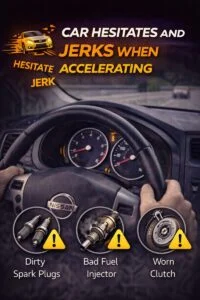
Dirty or partially clogged fuel injectors deliver uneven fuel spray. At idle, the engine compensates, but during acceleration, inconsistent fuel delivery causes jerking.
Low-quality or contaminated fuel can also disrupt combustion. Water or debris in the fuel system often causes intermittent hesitation that feels unpredictable.
Airflow Problems That Affect Throttle Response
Airflow must increase smoothly during acceleration. When it does not, hesitation follows.
The throttle body controls airflow into the engine. Over time, carbon buildup restricts airflow at small throttle openings. When the throttle opens during acceleration, airflow may lag behind throttle input, causing hesitation.
The mass airflow sensor measures incoming air. If it becomes dirty or faulty, the engine computer miscalculates how much fuel to add. This mismatch causes uneven acceleration.
Vacuum leaks allow unmetered air into the engine. At idle, the engine adjusts, but during acceleration, the sudden change in airflow disrupts fuel balance and causes jerking.
Ignition System Problems That Cause Jerking
The ignition system must fire each cylinder precisely during acceleration.
Worn spark plugs struggle to ignite the air-fuel mixture under load. This causes misfires that feel like jerking or stumbling.
Failing ignition coils produce weak or inconsistent spark. The engine may run smoothly at low demand but misfire during acceleration.
Incorrect ignition timing, often caused by sensor issues, leads to delayed or early combustion. This creates hesitation, loss of power, and jerking sensations.
Ignition-related problems often worsen over time and may eventually trigger warning lights.
Sensor Failures That Confuse The Engine
Modern engines rely heavily on sensors to manage acceleration smoothly.
The throttle position sensor tells the engine computer how much throttle is applied. Incorrect readings cause delayed or uneven response.
The engine coolant temperature sensor affects fuel mixture during warm-up. If it sends incorrect data, the engine may hesitate during acceleration even after warming up.
Crankshaft and camshaft position sensors provide timing information. Intermittent signal loss causes sudden hesitation or jerking, often without warning lights at first.
Sensor-related issues are frustrating because they can come and go, making diagnosis difficult.
Transmission And Drivetrain Causes Of Jerking
Not all acceleration problems come from the engine.
Automatic transmissions rely on smooth gear changes. Worn transmission fluid, faulty solenoids, or software issues can cause delayed or harsh engagement during acceleration.
Continuously variable transmissions may cause hesitation or jerking when internal components struggle to adjust ratios smoothly.
In manual transmissions, worn clutches slip briefly before grabbing, creating hesitation followed by a sudden surge.
Drivetrain components such as CV joints and driveshafts can also cause jerking under load, especially during low-speed acceleration.
Exhaust Restrictions That Limit Power Delivery
Restricted exhaust flow makes acceleration difficult.
Clogged catalytic converters increase backpressure. The engine struggles to expel exhaust gases, causing hesitation and jerking when power demand rises.
This problem often worsens over time and is usually accompanied by reduced power and poor fuel economy.
Electrical And Charging System Influence
Stable voltage is critical during acceleration.
A weak alternator or failing battery may not provide consistent power to sensors and control modules. Voltage drops cause delayed responses and jerking.
Poor ground connections create similar symptoms. Electrical interruptions often appear only under load, making acceleration behavior erratic.
Why The Problem May Come And Go
Many hesitation and jerking issues are intermittent.
Heat affects sensors, wiring, and fuel delivery. Problems may appear only after the engine warms up or during hot weather.
Driving conditions matter as well. Uphill driving, towing, or heavy acceleration places more stress on systems, revealing weaknesses.
This inconsistency often leads drivers to delay repairs, assuming the issue resolved itself.
How The Issue Typically Progresses
Hesitation and jerking rarely improve without intervention.
Minor fuel or airflow issues worsen as components continue to clog or wear.
Ignition problems escalate from occasional misfires to constant rough running.
Transmission-related jerking often becomes harsher and more frequent.
Early diagnosis keeps repairs manageable and prevents secondary damage.
Practical Ways To Narrow Down The Cause
Observation is the first step. Note when the problem occurs and under what conditions.
Listen for misfires, sputtering, or unusual noises during acceleration.
Watch for warning lights, even if they appear briefly.
Scanning for diagnostic codes provides valuable direction, even when the check engine light is off.
Visual inspections of hoses, wiring, and connectors often reveal obvious issues.
Fixes That Commonly Restore Smooth Acceleration
Fuel system cleaning or filter replacement often improves response.
Throttle body cleaning restores airflow control.
Replacing worn spark plugs and ignition components resolves many jerking issues.
Sensor cleaning or replacement improves engine accuracy.
Transmission fluid service improves shift quality and reduces hesitation.
Electrical repairs stabilize voltage and sensor operation.
Why Guessing Parts Leads To Frustration
Replacing parts without diagnosis often wastes time and money.
Many systems interact during acceleration. Fixing one symptom while ignoring others may not solve the problem.
Accurate diagnosis focuses on root cause rather than visible symptoms.
When Hesitation Becomes A Safety Concern
Severe hesitation or jerking during merging or passing creates risk.
Loss of power during acceleration can leave the car vulnerable in traffic.
If the problem worsens rapidly or is accompanied by warning lights, inspection should not be delayed.
Preventing Hesitation And Jerking In The Future
Regular maintenance keeps fuel, air, and ignition systems clean.
Using quality fuel reduces deposit buildup.
Addressing small drivability changes early prevents major issues.
Timely transmission service improves smooth power delivery.
Final Thoughts
A car that hesitates and jerks when accelerating is telling you that power delivery is no longer smooth or balanced. While the car may still be drivable, the behavior reflects stress within fuel, air, ignition, or drivetrain systems. Ignoring it rarely leads to improvement.
The encouraging reality is that most causes are well understood and fixable when addressed early. Careful observation, proper diagnosis, and targeted repairs restore smooth acceleration and confidence behind the wheel.
When acceleration feels predictable again, it confirms that the engine and drivetrain are working together as they should.